One parcel, six clocks, and only one of them is yours
A haul does not share a return window. Each item starts its own the hour it is checked in, and the parcel cannot ship until the slowest seller delivers. That gap is the real cost of consolidating.
Type what you are looking for, in English. Results are product cards you can hand to the agent.
Browse
The categories most people batch are the first four. Two of them have conditions attached once the box is open.







The argument
The clock belongs to the item, not to the box
Everything else on this page follows from one sentence in the agent's returns policy, and the sentence is about items.
An order turns Warehoused when the warehouse checks it in. From the next whole hour, there are 120 hours in which a return can be requested under the platform seller's guarantee. Five days, counted per order, starting at different moments for every seller in your haul.
Nothing about shipping them together changes that. So a batch assembled over ten days is a batch in which the early items have no recourse left by the time the last one arrives. Here is the same haul as six rows, on the day the jacket finally lands.
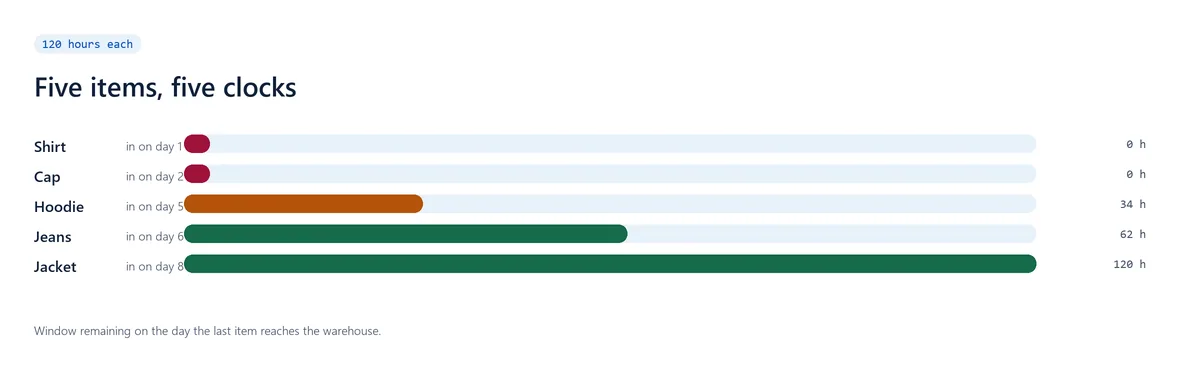
- Shirt, seller AWindow closed 6 h ago
- Cap, seller B16 h left
- Hoodie, seller C42 h left
- Jeans, seller C66 h left
- Jacket, seller D112 h left
- Socks, seller DNo window to lose
States come from the published rule: more than 24 hours left, 24 or fewer, closed, or never covered. The socks are in one of the nine excluded categories, so waiting costs them nothing because there was nothing to lose.
Cost one
Time, which you cannot buy back
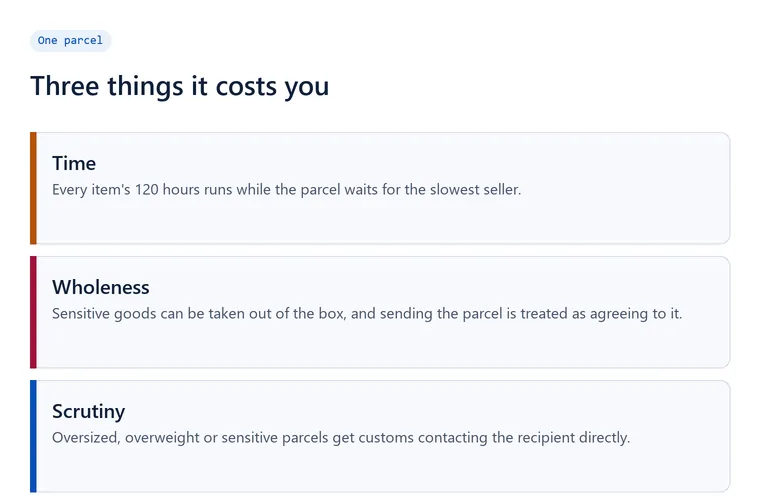
The window is not the only clock. Three run at once and only one of them is under your control.
The first is the window itself: 120 hours per item, already running. The second is the slowest seller, who decides when the parcel can ship and is not told you are waiting. The third is your own willingness to hold the box for one more thing, which feels free and is the only one of the three that costs you recourse directly.
There is a second limit stacked on top. Free returns are once in any thirty days; the policy says such service "can only be enjoyed once for free within 30 days". So a batch does not just lose windows, it competes for a single free use of the one that is left.
Cost two
The box may not arrive with everything in it
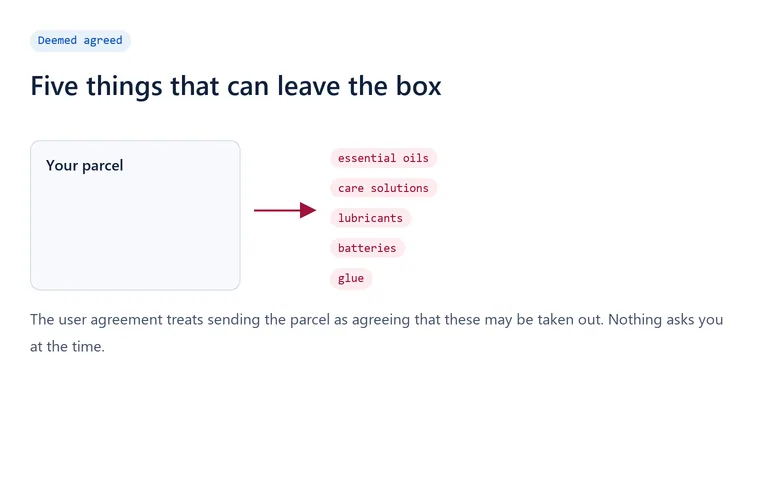
Some goods can be taken out of a parcel before it ships, and the agreement treats sending the parcel as your consent. The clause is worth reading in its own words: "it is deemed that you agree and approve" the removal of sensitive goods.
The named examples are essential oils, care solutions, lubricants, batteries and glue. None of them look like contraband in a shopping cart, and two of them turn up in orders nobody would call risky: a bottle of leather conditioner, a wristwatch that still has its cell fitted.
Nothing asks you at the time. There is no step in the flow where you approve the removal, which is what the word deemed is doing in that sentence. If an item matters, it ships in its own parcel or it does not ship.
Cost three
Who gets contacted when the parcel is unusual
Consolidation makes a parcel bigger, heavier, and more mixed. All three are the conditions under which the published process stops being between you and the agent.
| Situation | What the policy says happens |
|---|---|
| Parcel is oversized, overweight, or holds sensitive goods | Customs may contact the recipient directly for invoices or clearance documents. The agent makes no promises about clearance. |
| Stopped by domestic security before export | The agent may arrange a free reshipment. |
| Returned after export, for any reason | The reshipping cost is yours, including failed delivery, a wrong or incomplete address, and nobody home. |
| Lost, damaged or delayed by the carrier | Carried by third parties; the agent does not accept that risk. |
The asymmetry in the middle two rows is the part worth remembering. A parcel stopped at home may be reshipped free; the same parcel stopped abroad is reshipped at your cost. The difference is a border, and consolidating is what puts enough value in one box to make the second case expensive.
The chain
The steps, from a seller's page to your door
Four steps, and the clock starts at the second one. Most advice about consolidating never mentions which step it is.
You find a listing and the agent buys it
Nothing is running yet. The seller ships to the warehouse on their own schedule, and this is the stretch where a slow seller does no damage.
The warehouse checks it in and photographs it
The order turns Warehoused and the 120 hours begin at the next whole hour. The inspection photos arrive around now, which makes this the moment the clock and the evidence are both available. What the photos can settle.
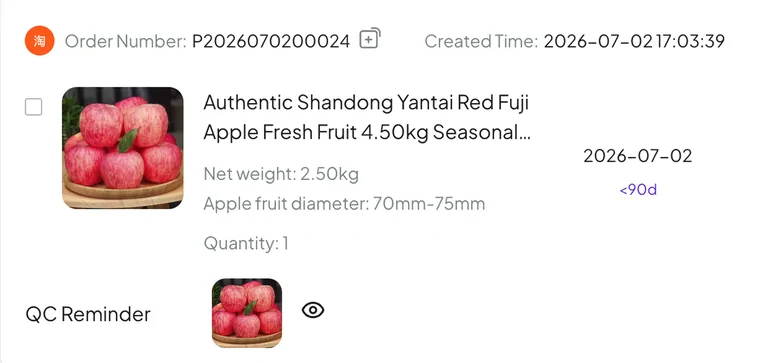
Warehoused is a status, and it is the one that starts the window. You choose a line and pay the freight
Each line has its own price and its own rules about what it will carry. Choosing here is also when the parcel's contents stop being changeable.
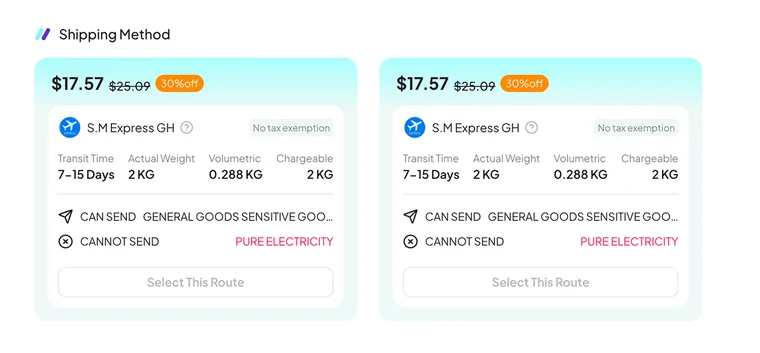
Lines differ on price and on what they refuse to carry. One row per parcel, and the windows are already decided
By the time the order list shows a parcel in transit, every window inside it has either been used or has expired. Nothing after this step is recoverable, which is why the decision worth making carefully is the one two steps back.
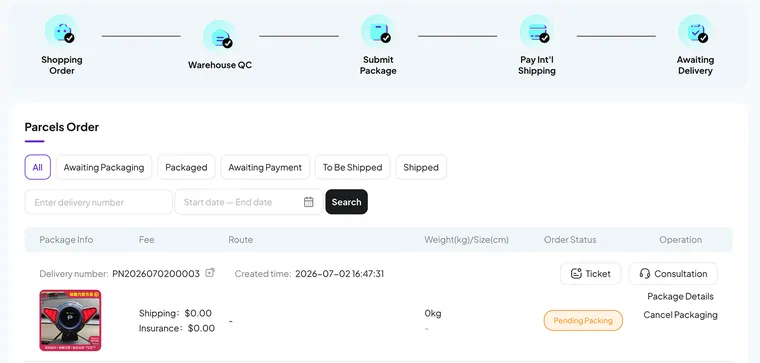
One row per parcel, and six separate histories inside it.
Questions
What people try first
Can I ask the warehouse to hold the window open?
No. The window is a term of the platform seller's guarantee and runs from check-in. What you can change is when you buy, which is the only lever that moves it.
Does splitting into two parcels help?
It changes the freight, not the windows. The windows are already set by arrival dates. Splitting helps when one item is sensitive or fragile and you would rather it travelled alone; it does not buy back a closed window.
What if an item arrives wrong and the window has closed?
It becomes a conversation with the seller rather than a guaranteed return. Keep the inspection photos: they are dated, they came from the warehouse, and they are the only contemporaneous record either side has.
Is there a way to see all of this for my own batch?
That is what return budget is for. Enter what is in the warehouse and how long you mean to wait, and it works out which windows close and which item should keep the one free return.
Two kinds of goods
The same box, under two different rulebooks
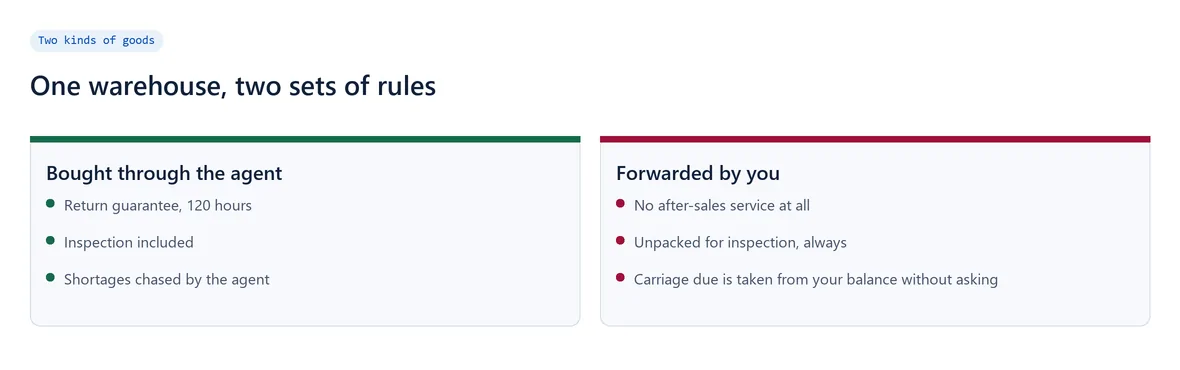
One more thing changes the arithmetic, and walking into it is easy. Goods the agent buys for you and goods you post to the warehouse yourself sit in the same parcel and are governed differently. The forwarded ones have no after-sales service at all, in the agent's own words, and carriage due on them is taken from your balance without a confirmation step.
Mixing them is allowed and sometimes sensible. Doing it without knowing which half of the box has recourse is how people end up arguing about an item that never had any. Forwarding sets out the four steps and what each one commits you to.
For a batch that already exists, the arithmetic on this page is done for you: put the items in and see which windows the wait closes. Work out your own batch.