
Work out what another two days of waiting costs
Put in what is already in the warehouse and how much longer you mean to hold the parcel. The answer is how many return windows that wait closes, and which item should keep the one free return.
Type what you are looking for, in English. Results are product cards you can hand to the agent.
Browse
Browse first if the batch is still hypothetical; the budget below works on items that have already arrived.






The budget
Six items, four sellers, one more to wait for
The example loaded is a real shape: six items that reached the warehouse over five days, and a decision about whether to wait another two for one more seller. Change any number and the answer changes with it.
Waiting that long costs 2 items their recourse.
- Shirt, seller AWindow closed 54 h ago
- Cap, seller BWindow closed 32 h agowas 16 h left
- Hoodie, seller CWindow closed 6 h agowas 42 h left
- Jeans, seller C18 h leftwas 66 h left
- Jacket, seller D64 h left
- Socks, seller DNo window to lose
- 1 item is excluded by category, so it has nothing to lose by waiting.
- Waiting another 48 hours ends the window on 2 more items.
- If you only get one free return in 30 days, Jeans, seller C is the one to hold it for: it runs out first.
An unconditional return costs the freight out, the freight back and a 5 RMB service fee (as published on 2026-08-04), and only 1 return in any 30 days is free. The seller still has to agree to it.
Counted from the published rule: 120 hours per item, from the next whole hour after it turns Warehoused. Hours here are hours since check-in, which is what the order page shows.
If an item is close to the modelled deadline, inspect it and raise any return request now. Waiting for another seller or shipping the item internationally does not extend a return window. Confirm eligibility with the agent before committing the parcel.
And if you are going to ask for a return, do it while the photographs taken at check-in are the freshest evidence either side has. What those photographs can settle.
How to read it
The free return is a resource, not a right
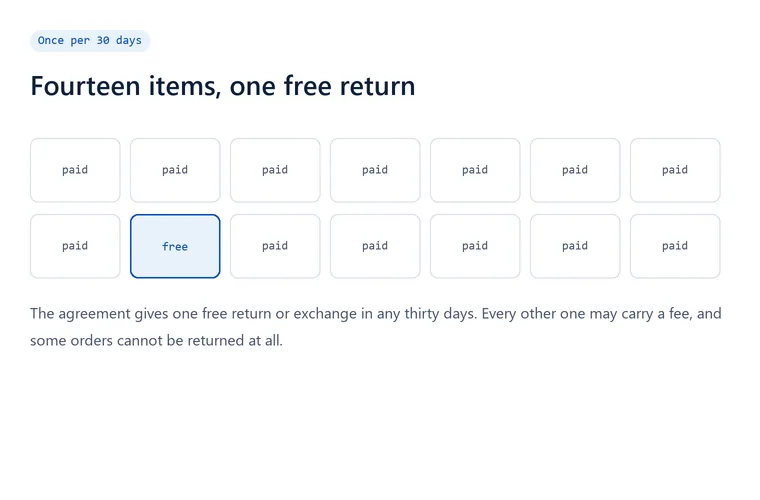
The line that matters most is usually the last one. Free returns are once in any thirty days, so a batch of six does not have six chances; it has one free chance and five that may cost a fee, with some orders not returnable at all.
That turns a vague worry into a choice. If two items are still inside the window and one has 14 hours left while the other has 90, the free return belongs to the one running out first, because the other one can still be dealt with tomorrow. The tool names that item rather than leaving you to work it out.
The example as loaded ends up with 2 of six still inside the window after the wait, and the verdict reads: Waiting that long costs 2 items their recourse.
What it costs
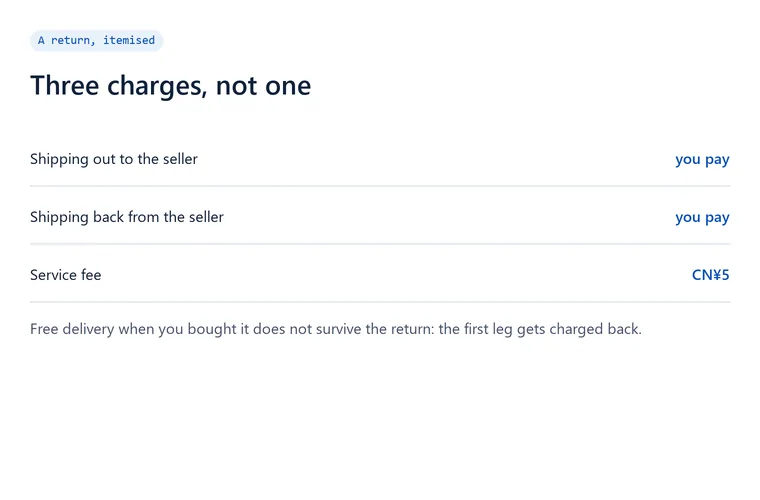
Three charges, and the first one surprises people
An unconditional return is not free even when it is allowed. You pay to send the item to the seller, you pay for the seller's leg, and there is a service fee on top: 5 RMB, as published on 2026-08-04.
The part that catches people is the first leg. If the seller offered free delivery when you bought it, that cost comes back when you return it: the published term charges the original shipping back. Free delivery is a sales term, not a property of the parcel.
There is also a precondition that has nothing to do with the goods. Your account balance has to cover the return freight and the fee at the moment you apply. A balance drained by paying for shipping can block a return that is otherwise still inside its window, and the window keeps running while you top up.
Conditions
All three have to hold, not any one of them
The tool treats the window as the variable because it is the only one of the three you control. Know the remaining two before counting on any of this.
| Condition | What it means in practice |
|---|---|
| The seller offers the guarantee | It is the platform seller's service. A listing from a seller who does not offer it has no window at all, whatever the category. |
| The item is in a sellable state | The seller's definition, not yours. For six categories that comes down to a seal, a clasp, a sticker or a counter being intact. |
| No more than five days since check-in | The 120 hours, per item, from the next whole hour after it turned Warehoused. |
Who pays depends on a fourth thing: who the policy holds responsible. It names three cases. Customer covers changing your mind, ordering the wrong thing or finding the freight over budget, and also a seller deciding there is no fault. Seller covers a wrong item or a real defect, and then the return freight is usually not yours, unless the seller insists. Others covers damage already done in transit inside China.
Note which way the default falls in the first case: a seller who says the item is fine turns a quality complaint into a change of mind. That is the case the returns policy is for. Photographs taken at check-in are what move an argument out of it, which is what the inspection page is about.
Questions
About the number it just gave you
Is this a shipping calculator?
No, and deliberately not. It does not price freight or compare lines. It answers the one question a freight calculator cannot: what the wait costs you in recourse.
Where does it get the 120 hours from?
From the agent's own returns page, which defines five days as 120 hours counted from the next whole hour after the order turns Warehoused. The number is loaded from one file that also feeds the prose, so the page and the tool cannot disagree.
Why does the category matter?
Because nine categories have no window at all and six more depend on a physical condition. An excluded item has nothing to lose by waiting, so counting it as a loss would overstate the cost of consolidating. The tool marks those rows separately.
Does it send my batch anywhere?
No. It runs in the page and keeps nothing. There is no account here and nothing to sign in to.